Student Homelessness in New York City, 2025–26
Today Advocates for Children of New York released new data, obtained from the New York State Education Department (NYSED), showing that more than 138,000 New York City public school students — about one in every eight — experienced homelessness during the 2025–26 school year. Of these students, more than 50,700 (37%) spent time in shelter and 81,100 (58%) were “doubled up,” or temporarily sharing the housing of others because of a loss of housing or economic hardship.
The total number of students in temporary housing fell 10% from 2024–25 to 2025–26, driven largely by a 22% drop in the number of students living in shelter. While Manhattan saw the most significant changes relative to 2024–25, every borough experienced declines in both the number and percentage of students identified as homeless. As in prior years, the Bronx had the highest overall rate of student homelessness, while Staten Island had the lowest, and there was notable variation across the City’s 32 community school districts. More than one in five students attending school in District 9 (Highbridge and Grand Concourse), 23 (Brownsville), and 32 (Bushwick) was homeless during the 2025–26 school year. In District 23, more than one in eight students was in shelter, roughly triple the Citywide rate.
“While it’s encouraging to see that student homelessness is declining after reaching historic highs in 2024–25, today’s data is no cause for celebration,” said Maria Odom, Executive Director of AFC. “Last year was the eleventh year in a row that more than 100,000 City students — roughly equivalent to the entire population of Albany — lacked permanent housing.”
Students who are homeless, and especially those living in shelter, face tremendous barriers to success in school. As described in AFC’s Educational Indicators for Students Experiencing Homelessness:
- Nearly half of all students in temporary housing and 63% of those in shelter were chronically absent in 2024–25 — rates of absenteeism that represent a combined 1.1 million days of lost instructional time, at minimum.
- One in every five students in shelter transferred schools at least once during the 2024–25 school year, more than four times the mid-year transfer rate for permanently housed students.
- In 2025, only 27% of third–eighth graders living in shelter were reading proficiently, according to the state tests, less than half the proficiency rate of their permanently housed peers.
- Only 59% of students in shelter graduated high school on time in 2025, while 14% dropped out, roughly triple the dropout rate for students with permanent housing.
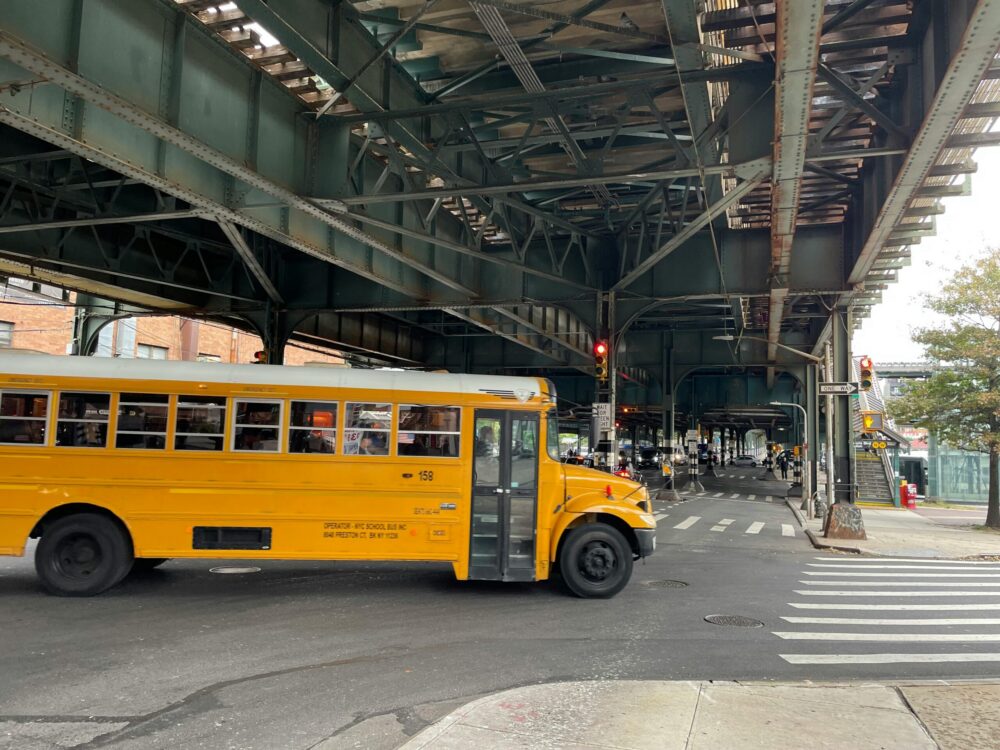
School can be a refuge for children whose housing is unstable, making it all the more critical that the City ensure students experiencing homelessness have the transportation, services, and support they need to get to class every day and access a quality education. New York City Public Schools (NYCPS) has taken important steps in recent years to bolster support for students who are homeless, such as hiring shelter-based coordinators to focus on education, but many gaps remain. For example, last year 37% of families were initially placed in a shelter in an entirely different borough than their youngest child’s school — often resulting in long commutes, missed instructional time due to problems with yellow bus service, or unnecessary school transfers that separate children from friends, teachers, and familiar routines at a time when they badly need stability. And 1,775 students in shelter ended the 2025–26 school year waiting for bus service, either because their transportation preference was not captured in the City’s data system or because there was no bus available for them. Addressing such barriers requires interagency coordination and collaboration.
“Every child in New York City deserves a permanent place to call home — and in the interim, it’s essential that students who are homeless get the support they need to be successful in school,” said Jennifer Pringle, Director of AFC’s Learners in Temporary Housing Project. “That starts with overhauling the decades-old bus contracts and improving transportation so children can get to school in the first place, as well as breaking down the bureaucratic silos that stand in the way of developing systemic solutions on issues like far-flung shelter placements.”